Django Action Triggers Documentation





Welcome to the documentation for Django Action Triggers (django-action-triggers), a flexible Django application that allows you to asynchronously trigger actions based on changes in the database.
Overview
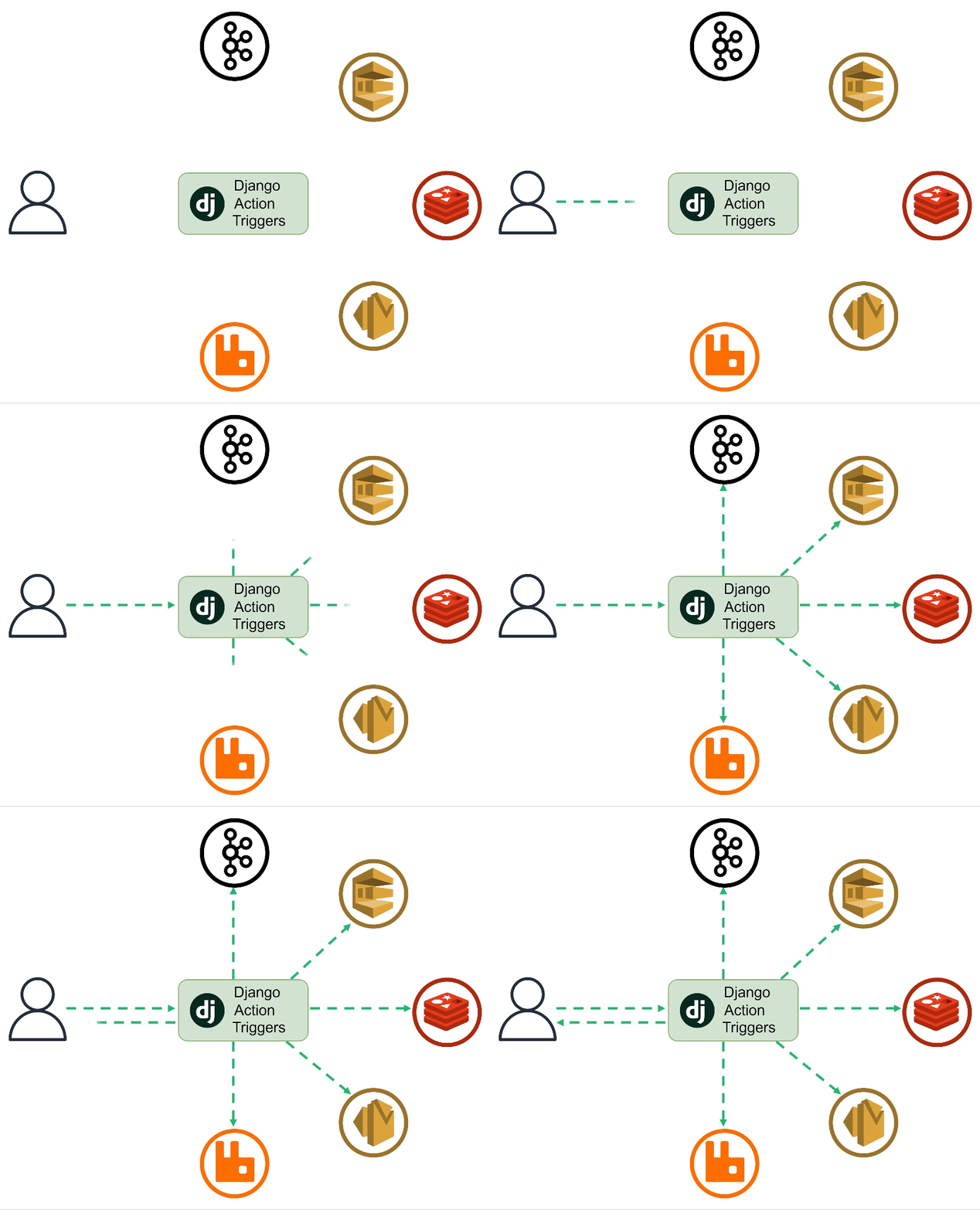
In Django Action Triggers, a “trigger” refers to an event that
initiates a corresponding “action”. Triggers are typically associated with
database changes, such as creating, updating, or deleting records,
while actions define the code that is executed in response to those changes.
Why Django Action Triggers Over Django Signals?
In Django, signals are often hardcoded into a signals.py file to define actions that happen when specific events occur (like saving or deleting a model instance). While this is useful, it can have several limitations:
Changes require redeployments: To add, remove, or update a signal, you must modify the code and redeploy your application.
Static configuration: Signals are hardcoded, meaning there’s little flexibility for runtime changes.
Maintenance burden: As your application grows, managing multiple signals across different models can become cumbersome.
No out-of-the-box integrations: Integrating signals with external services like AWS, RabbitMQ, Kafka, etc., requires additional custom code.
How Django Action Triggers Helps
Django Action Triggers addresses these limitations by providing:
Dynamic signal management: You can add, update, or remove signals without touching the codebase. Everything is managed through the Django admin interface or via the API, allowing for quick adjustments and runtime flexibility.
Built-in support for external services: Seamless integration with popular message brokers such as AWS SQS, Kafka, RabbitMQ, and more, without the need for additional custom code.
Asynchronous actions: Actions are handled asynchronously, ensuring that each trigger is processed efficiently without blocking the main thread.
Flexibility and scalability: As your application grows, Django Action Triggers simplifies signal management, allowing you to easily scale and integrate with third-party services.
In short, Django Action Triggers allows you to manage and extend signal-driven workflows at runtime, while also providing built-in integrations with external services. It removes the need for code modifications and redeployments, offering a more flexible and maintainable approach.
Supported Actions
Webhooks: Send HTTP requests to specified URLs when triggers are activated.
Message Brokers: Send messages to messaging brokers like Kafka and RabbitMQ.
Actions: Execute other actions such as invoking an AWS Lambda function.
Key Features
Database-Driven Triggers: Automatically trigger actions based on specific database changes, such as model save events.
Flexible Action Handling: Integrate with a variety of external systems via webhooks and messaging brokers.
Extensible: Easily extend to support custom triggers, actions, and integration points.
Dynamic Configuration: Dynamically set values at runtime, allowing for secure and flexible handling of sensitive information.
Contents
This documentation is organised into the following sections:
Message Broker Integrations
Action Integrations
Modules
Indices and tables
Use the following resources to quickly find what you’re looking for:
Additional Resources
For more information on specific topics, refer to the relevant sections of this documentation. If you encounter any issues or have questions, please raise an issue on the GitHub repository.